Production · 7 min read
Why footage looks amateur — and why it is rarely the camera
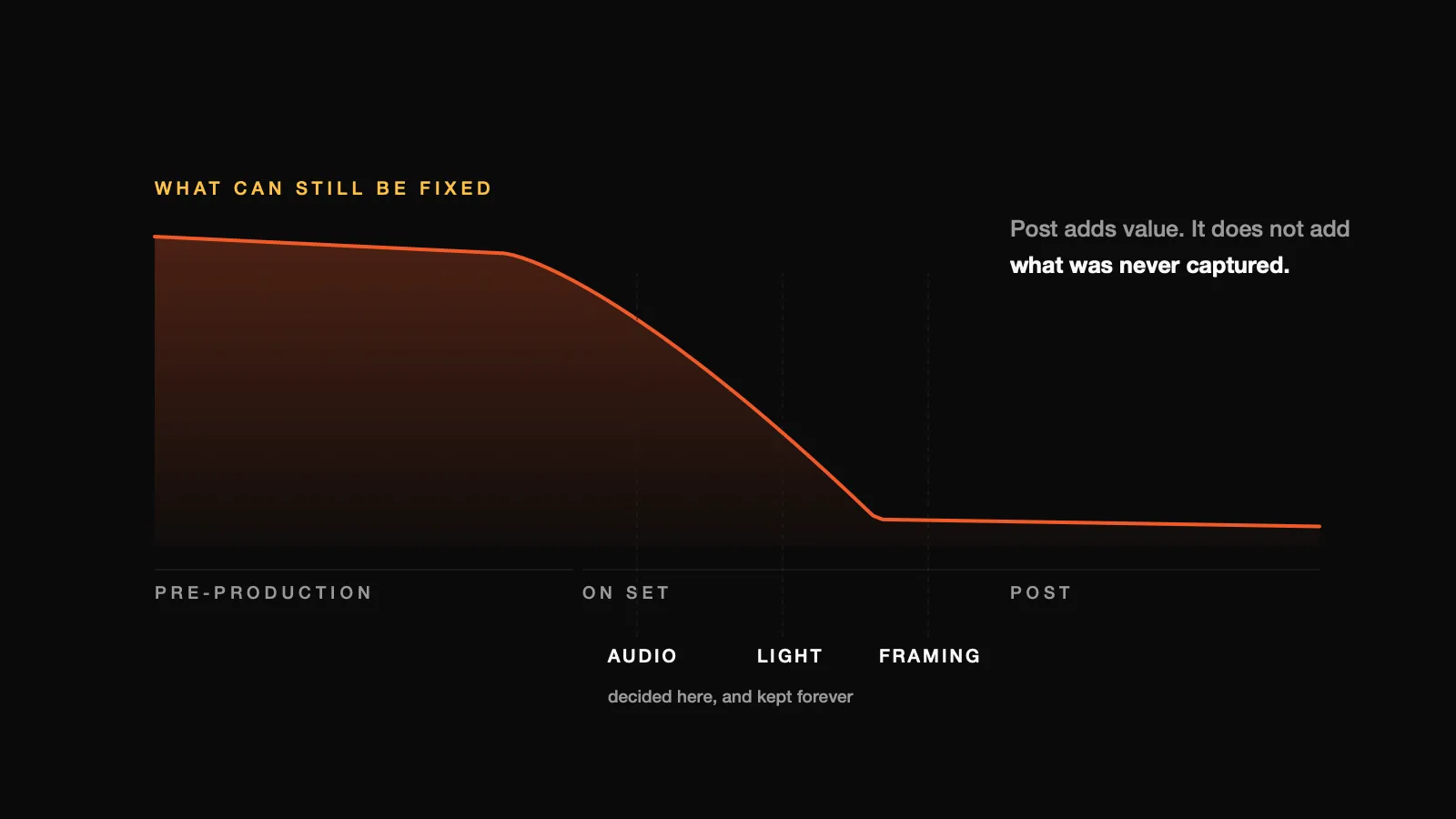
What makes content look and sound professional is settled on the day, mostly before anyone presses record, and rarely recoverable after.
Most people can tell within a few seconds whether something was made properly. Very few can say why.
The assumption is usually that it comes down to equipment — a better camera, a higher resolution, a bigger budget. It almost never does. The difference between content that looks professional and content that looks improvised is decided by a handful of things, most of them settled before anyone presses record, and most of them impossible to recover afterwards.
Audio is what people actually notice
This is the one that surprises clients most, so it is worth stating plainly: an audience will forgive a soft picture long before it forgives bad sound.
Grainy footage with clean audio reads as authentic. A beautifully shot interview in a room with hard walls and an air-conditioning hum reads as amateur, however good the camera was. People do not consciously notice good audio. They simply keep watching. When it is wrong they stop, and they usually could not tell you what was wrong — only that it felt cheap.
This applies doubly to interviews, where the room does more damage than the camera.
The unforgiving part is that audio is the hardest thing to repair. A picture can be graded, stabilised, cropped and sharpened. Room reverb cannot be removed once it is on the recording, because it is not noise sitting on top of the voice — it is the voice, arriving twice. The only real fix is to have recorded it somewhere else.
Which is why the room matters more than the microphone. A modest lapel mic in a carpeted room with soft furnishings will beat an expensive one in a glass-walled boardroom, every time.
Light is the difference, not resolution
Resolution is the most marketed and least important variable in the chain.
A camera does not see; it collects light. Give it enough of it, from the right direction, and almost any modern sensor produces something that looks considered. Starve it, and the image turns noisy, the colours drift, and skin takes on the greenish cast that every viewer reads as filmed on a phone in an office — regardless of the 4K badge on the file.
Controlled lighting is what separates the two. Not necessarily a large lighting package: often it is one properly placed source, a reflector, and the discipline to turn off the fluorescent panel overhead. What it never is, is accepting whatever the room happens to offer and hoping.
Available light is a legitimate choice. It stops being one when it is a default.
What post-production can and cannot do
Post is where a great deal of value is added, and where a great deal of misplaced hope goes to die.
It can colour grade, cut for pace, stabilise, clean up, mix, subtitle, and assemble the same material into five different deliverables. That last one is where most of the return sits, and it is routinely underused.
What it cannot do is recover information that was never captured. A blown highlight has no detail behind it to bring back. An out-of-focus take is out of focus permanently. A room’s reverb stays. And no edit produces the reaction shot that nobody filmed, because the camera was pointing the other way when the interesting thing happened.
“We will fix it in post” is occasionally a plan. Far more often it means paying twice for a worse result — once on the day, once again to partially undo it.
The decisions that matter happen before the shoot
Almost everything above is determined by choices that cost nothing to make well.
Which room. What time of day, if there are windows. Whether there is somewhere quiet to record an interview, or whether the only available space sits under an air-conditioning vent. Where the power is. How long access lasts, and therefore how many setups are realistic rather than hoped for.
None of these are creative decisions and none require budget. They require somebody to ask in advance, which is the part most commonly skipped — and the reason a crew turning up to a location they have never seen is a genuine risk rather than a formality.
What this means when you commission
Three things worth asking of anyone quoting for production work.
- How are you recording the sound? (More questions worth asking before you commission.) If the answer involves the camera’s onboard microphone for anything other than reference, expect the result to sound like a video call.
- What are you doing about light? “We will use the natural light” may be right, but it should be a decision with a reason behind it, not an absence of one.
- Have you seen the location? If not, someone is guessing about acoustics, power and space — and those guesses are settled on the day, at your cost.
The answers tell you more about the likely quality of the finished piece than the camera specification ever will — and they are the questions a production process should have answered before a shoot date is set.
The short version
Content looks professional when the boring things were handled properly. Quiet room, controlled light, a plan for what happens in the edit, and somebody who checked the space before the day.
None of it is glamorous, and all of it is decided long before anyone sees a first cut.