Content strategy · 7 min read
Why being right is no longer enough
Audiences discount much of what they are told, including the accurate parts. Credibility now has to be shown rather than stated.
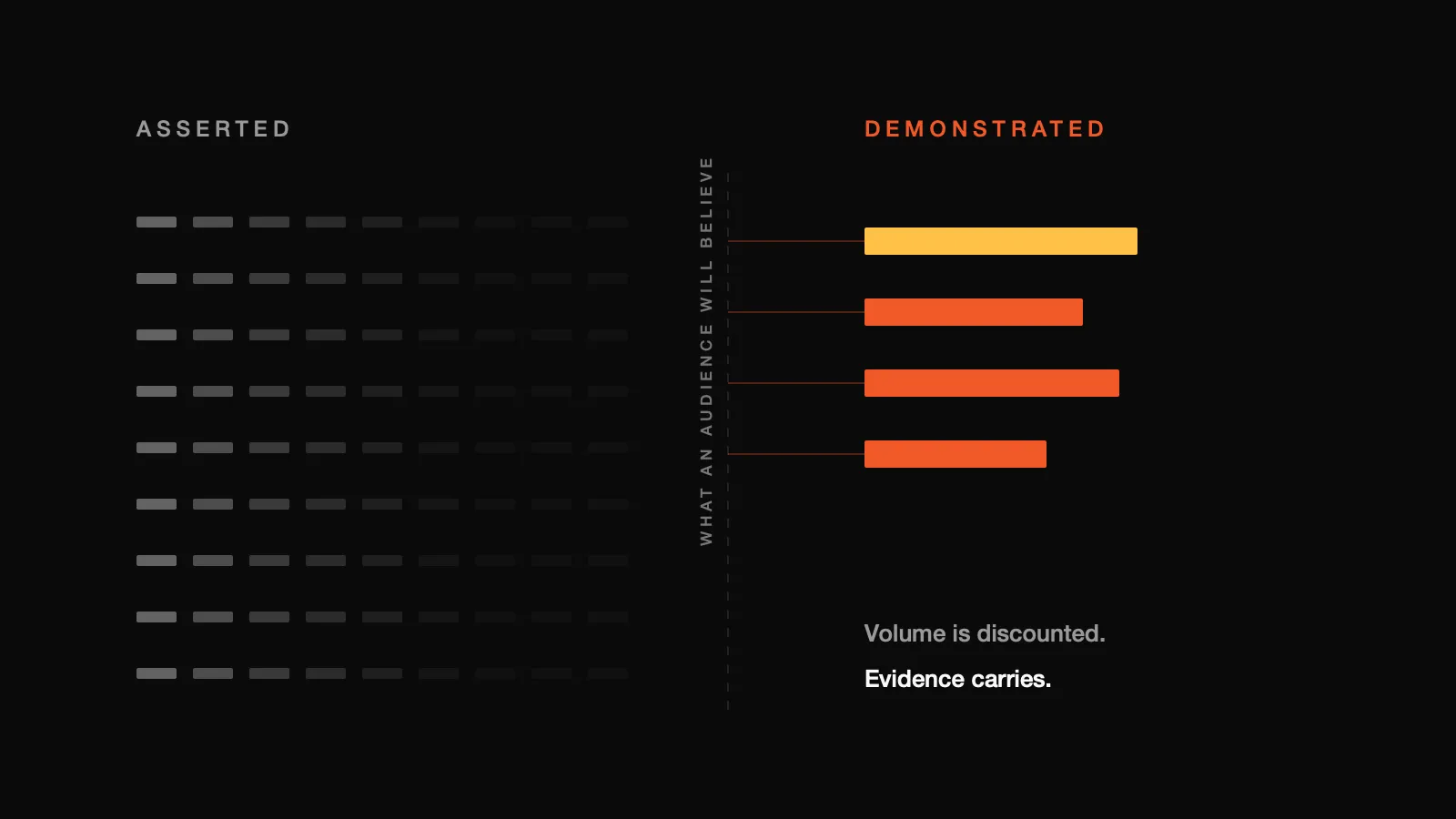
Being trustworthy and being trusted are no longer the same thing.
There is more information available than at any point in history, and less agreement about which of it is reliable. Audiences have adapted the only way they reasonably can, by discounting a great deal of what they are told — including the parts that are accurate.
That is the environment every organisation now communicates into, and it is where a considerable amount of well-intentioned content quietly fails.
Volume is not the constraint
More is published each day than anyone could read in a lifetime. Whatever is preventing an organisation from being properly understood, it has not been a shortage of material for some time.
This is worth pausing on, because a great deal of content planning still proceeds as though the opposite were true. Calendars are built around frequency. Performance is measured in output. The underlying assumption is that publishing enough will eventually produce understanding.
It rarely does. Contributing more to an oversupplied market is not a strategy, and the organisations struggling to be believed are seldom the ones publishing too little.
Credibility has become the scarce resource
When anything can be asserted at negligible cost, audiences stop assessing statements individually. There is not enough attention available to verify what arrives, so people rely on shortcuts: familiarity, consistency, and whether something appears to be working too hard to persuade them.
A well-founded statement and an unfounded one often arrive looking much the same. Faced with that, discounting both is a sensible response. The consequence is that an accurate message holds no inherent advantage over an inaccurate one. It has to establish credibility on something beyond being correct.
Many organisations have never had to account for this. The working assumption is that the substance is the difficult part and communication is delivery. That was closer to true than it is now.
The cost of a credibility gap
The costs are indirect, which is why they are so often missed.
Genuine expertise is discounted alongside everything else. Real outcomes read as marketing, because that is usually the context in which outcomes are described. Work that took months to deliver receives the same passing attention as an assertion that took a minute to write.
The organisation understands the difference. The audience has no way to see it. So the distance between how capable an organisation is and how capable it appears continues to widen — and the instinctive response, to state it more often and more emphatically, tends to widen it further. Emphasis is precisely what audiences have learned to discount.
Demonstration rather than assertion
One thing continues to travel through a sceptical environment largely intact, and it is not a better-phrased statement.
It is demonstration.
A description of a well-run event can be written by anyone, about any event, in moments. Footage of that event — the room filling, a speaker mid-sentence, an audience genuinely engaged — belongs to a different category. It does not describe what happened. It shows it, and it could not exist unless it had. That is the whole argument for showing the work rather than describing it.
This is what is lost when production is treated as presentation, and most of what decides whether it holds up is settled on the shoot day. A brand film is not a more attractive way of restating a paragraph. Properly made, it is the version that carries its own credibility, because something real had to take place in front of a camera for it to exist.
On AI
We use whatever makes the work better and faster, AI included, and we produce AI-generated content where a brief genuinely calls for it.
What determines whether an organisation is believed is not the tools involved. It is whether there was something worth documenting, and whether it was documented well.
What this means for a brief
If demonstration is what carries, briefs are better built around what can be shown than around what needs to be said.
In practice, three questions before anything is scheduled:
- What is the specific claim? Not the theme or the topic, but the particular thing you want someone to finish believing.
- What would demonstrate it? A real moment, a measurable outcome, or someone who can speak to it credibly without a script.
- Where does that person actually spend their attention? Something convincing, published where the relevant audience never goes, convinces nobody.
Most briefs answer none of these. They specify a format, a length and a delivery date, which describes the artefact without establishing its purpose. What to ask before commissioning covers the rest.
Why we will challenge a brief
If what has been requested claims more than the situation supports, we will say so, and we would rather decline the work than produce it.
That is not a service promise so much as self-interest. Overstated content is the reason audiences discount everything, and each piece of it makes the next honest thing harder to land. There is no sense in contributing to that and then offering to solve it.
What this means in practice
Put accurate information in front of the people it is intended for, in a form that gives them reason to believe it. That is a more demanding standard than it sounds, and it rules out a good deal of what is routinely commissioned.
Applied consistently, it means capable organisations are recognised as capable more often than they otherwise would be. Which is a measured claim about a significant problem, and roughly as much as anyone should promise.