Social · 7 min read
Why brand social underperforms
Most brands copy the format of creator content without any of the conditions that make it work. The result looks native and performs like an advert.
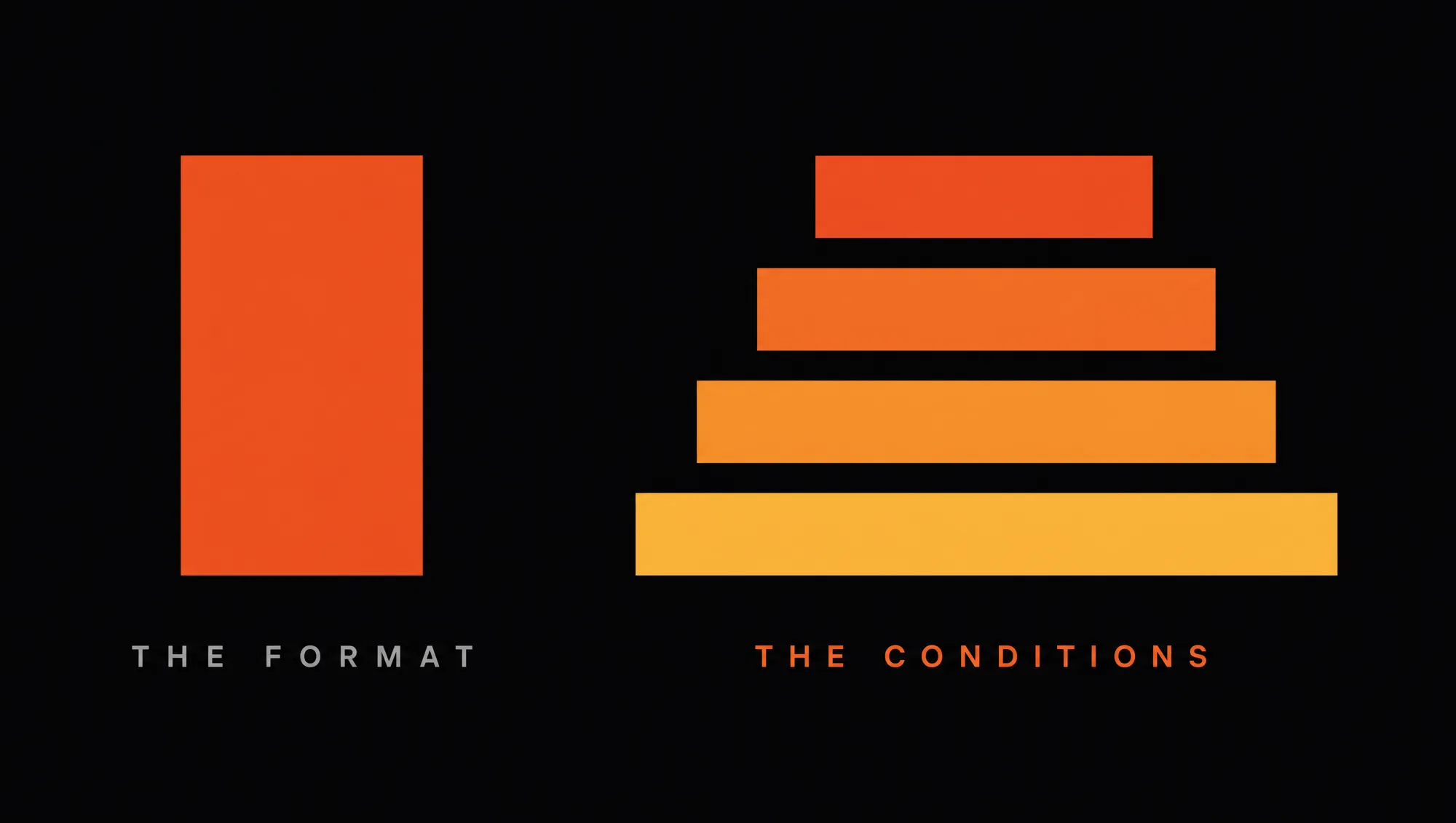
Vertical, handheld, unpolished, someone talking directly to camera. The format of content that performs on social is well understood by now, and widely copied.
Copying it rarely works, and the reason is not execution. It is that the format was never what made the original effective.
The format is the visible part
When a brand studies content that performs well on social, what it can see is the surface: the aspect ratio, the pacing, the absence of polish, the direct address.
Those things are easy to reproduce. A team can shoot vertically, cut quickly, remove the music bed and stop colour-grading to within an inch of its life. Two weeks later the content looks convincingly native, and performs about as well as the advert it replaced.
What was not visible, and therefore not copied, is everything holding the format up.
What actually sits behind it
Content that works on social generally has four things a brand does not automatically have.
A face people recognise. Not a celebrity — simply the same person, appearing consistently, long enough to become familiar. Familiarity is most of what makes direct-to-camera work, and it cannot be shortcut. A different presenter each time is a different stranger each time.
Volume. Creators publish frequently enough to be wrong often. That is not sloppiness, it is how the useful pieces get found. Publishing twice a month means every piece has to succeed, which produces cautious content, which does not succeed.
Speed of response. A great deal of what performs is reactive — a comment, a moment, a piece of news, answered while people are still interested. Content that takes three weeks to approve cannot be reactive, and reactive is a large share of the format.
Permission to have a view. Creator content is watchable largely because someone is saying what they actually think. Brand content routinely removes exactly that in review, and what is left is accurate, agreed, and of no interest to anyone.
Why it usually goes wrong at approval
Notice that three of those four are not production problems. They are organisational ones.
A brand can hire a crew that shoots beautifully for social and still produce content that does not work, because the constraints that matter sit upstream of the shoot: how often it can publish, how quickly it can approve, and how much of an opinion it is permitted to hold.
This is why “we tried social content and it did not perform” is so often a story about a review process rather than a story about content.
What to do instead
Two options, and the mistake is refusing to pick.
Build the conditions. Choose one person to be the face for at least six months. Agree a volume you can genuinely sustain. Give one named individual authority to approve within twenty-four hours, and accept that some pieces will be weaker than others because that is the mechanism working, not failing.
Or work with people who already have them. Creators and influencers have the face, the volume, the speed and the licence to have a view. Working with them means giving up a degree of control, which is precisely what makes it effective. A brand that hands over a script has simply bought an expensive advert in a native wrapper.
Both are legitimate. What does not work is wanting the results of the second while insisting on the control of a corporate video.
Where production genuinely helps
None of this makes craft irrelevant, but it changes what it is for.
This also sets a limit on what the format can achieve at all — short-form is a discovery mechanism rather than a closing one.
On social, production quality does not signal seriousness — it usually signals advertising, and the audience adjusts its attention accordingly. That is the same discounting reflex that makes assertion travel badly everywhere else. What is worth investing in is the part that survives: audio you can hear on a phone in public, a shot framed for vertical from the outset rather than cropped afterwards, and enough coverage in a single session to feed several weeks without the person being needed again. That is what social and UGC production is scoped to deliver.
That is what makes sustained volume possible for an organisation that cannot film every day. Which brings the whole thing back to the conditions rather than the format.
The short version
The format is copyable. The conditions are not, and the conditions are what the results come from.
Decide honestly whether you can build them. If you can, the format is straightforward. If you cannot, work with people who already have them — and let them do it their way, because their way is the product.